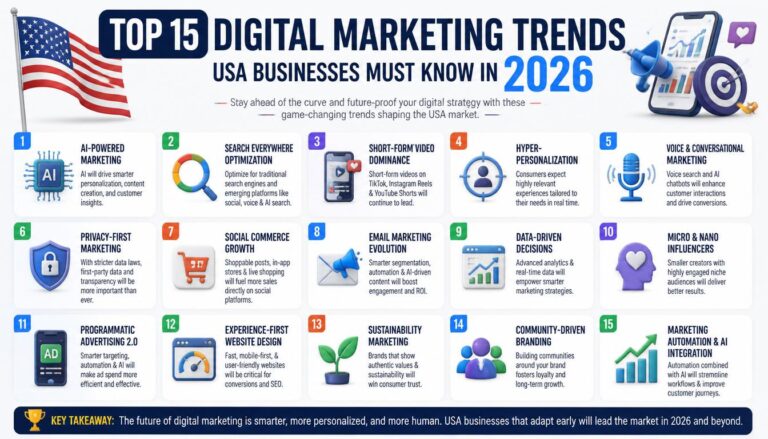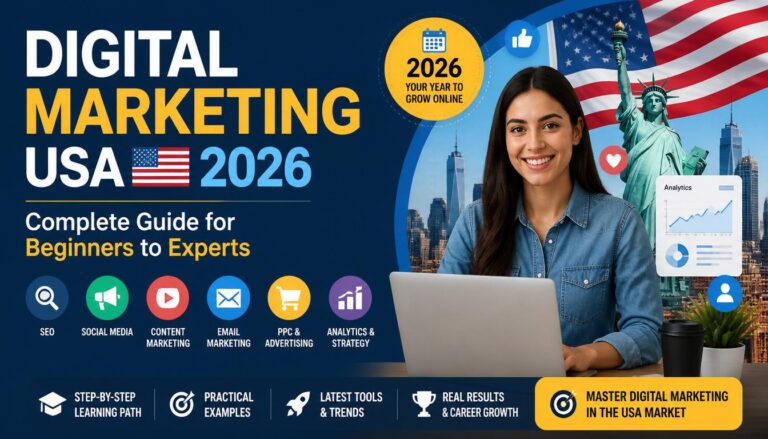
Hey there, fellow marketers (or business owners who secretly wish they could outsource all this stuff). It’s 2026, and if your digital strategy still looks like it did in 2023—throwing money at ads and praying for clicks—you’re basically bringing a flip phone to a smartphone party. In the USA, where everyone from New York coffee shops to California tech startups is fighting for attention, digital marketing has leveled up big time. Consumers are savvier, algorithms are smarter, and AI isn’t just a buzzword anymore; it’s the quiet coworker who actually gets things done.
This year, trends aren’t about flashy gimmicks. They’re about working smarter, building real trust, and not getting buried under a pile of AI-generated “content slop.” I pulled from reports like Gartner’s predictions and insights from marketers across the country to put together this no-nonsense guide. We’ll cover the top 10 trends dominating the USA scene right now, with real explanations, why they matter here, how to actually use them, and a few laughs along the way (because if marketing doesn’t make you chuckle sometimes, what’s the point?). Expect practical tips, lists, and even a table or two so you don’t doze off. Let’s dive in—your 2026 game plan starts here.
1. Agentic AI: Your Marketing Team’s New Overachieving Intern
Agentic AI isn’t your average chatbot that spits out generic replies. These are autonomous AI agents that handle entire customer journeys—sending personalized notifications, suggesting reorders, or even guiding someone through a purchase without you lifting a finger. According to Gartner, brands are adopting this to deliver true one-to-one interactions that feel effortless. In the USA, where busy professionals juggle work, kids, and endless scrolling, this trend is exploding because nobody has time for clunky funnels anymore.
Picture this: A customer browses your site at 11 p.m. after a long day. Instead of a pop-up begging for their email, an AI agent quietly notes their behavior and follows up the next morning with exactly what they need. No creepy vibes, just helpful. Why’s it dominating here? US marketers are leading the pack with AI adoption around 61% in some surveys, and consumers expect speed. If your competitor’s AI is closing sales while you’re still drafting emails, guess who wins?
Humor break: Remember when we thought “set it and forget it” was just for crockpots? Now it’s for your entire marketing stack. But don’t hand over the keys completely—AI still needs human oversight or it might suggest selling snow boots to someone in Miami.
Here’s a quick list of starter steps:
- Audit your current tools and pick one agentic platform (like those integrating with your CRM).
- Train it on your brand voice so it doesn’t sound like a robot reading a script.
- Start small: Let it handle abandoned cart reminders first.
| Benefit | Challenge | USA Tip |
|---|---|---|
| 24/7 personalization | Over-reliance risks errors | Tie it to first-party data for compliance with US privacy laws |
| Faster execution | Learning curve for teams | Pilot in one department, like e-commerce |
Expect this to save hours and boost conversions by making every touchpoint feel custom.
2. Hyper-Personalization: Goodbye, One-Size-Fits-All Campaigns
Personalization used to mean slapping a first name in an email. In 2026 USA, hyper-personalization means AI crunches real-time data—location, past buys, even mood from scrolling habits—to serve up experiences that feel almost psychic. Stats show 75% of consumers are more likely to buy from brands that nail this, and nearly half of marketing leaders hitting revenue goals credit it.
Why USA dominance? We’ve got diverse markets from coast to coast. A Texan dad gets football-themed ads while a Seattle hipster sees eco-friendly options. It’s not creepy if done right—it’s convenient. Brands using generative AI for this (now in 75% of strategies) are seeing real lifts.
Funny line: It’s like your phone knowing you want tacos at 2 a.m. after a night out—helpful, but if it starts suggesting therapy, maybe dial it back.
To implement:
- Collect zero-party data (ask customers what they like).
- Use AI to segment beyond demographics into intent-based groups.
- Test across channels: email, ads, website.
Detailed example: A clothing brand in Chicago uses hyper-personalization to show winter gear to locals during a cold snap, while sunny LA users see lightweight options. Engagement skyrockets because it feels relevant, not salesy.
This trend turns browsers into buyers faster than you can say “targeted ad.”
3. Short-Form Video Dominance (With AI Making It Even Easier)
Short-form video isn’t going anywhere—it’s still the attention king, especially on TikTok, Instagram Reels, and YouTube Shorts. In 2026, AI helps create and optimize it at scale, but the winners focus on authenticity over perfection. US consumers spend hours daily on this stuff, and brands turning videos into trust-builders (think quick demos or behind-the-scenes) are crushing it.
Gartner notes short-form video’s role in search and discovery now. Why here? America’s fast-paced culture loves quick, snackable content. A local plumber in Philly films a 15-second “before and after” fix and watches leads roll in.
Humor alert: Long blog posts are the kale of marketing—good for you, but nobody wants a full plate. Short videos? That’s the pizza—everyone grabs a slice.
Practical list:
- Post 3-5 times weekly, focusing on value (not just sales).
- Use AI for editing and captions, but film with real people.
- Track what stops scrolls: hooks in the first 3 seconds.
Table of video types that work best in 2026 USA:
| Video Style | Best For | Example ROI Tip |
|---|---|---|
| UGC-style testimonials | Trust-building | Boosts conversions 30%+ |
| Quick tips/how-tos | Local services | Drives website traffic |
| Trend-jacking with brand twist | Virality | Measure shares, not just views |
Keep it real, and watch your engagement metrics laugh at last year’s numbers.
4. Answer Engine Optimization (AEO): SEO’s Smarter Cousin
Forget obsessing over Google rankings. In 2026, AI search tools (like ChatGPT-style answers or Google’s overviews) pull direct responses from your content. AEO means structuring everything so AI cites you as the expert. Traditional SEO traffic is dropping because people get answers without clicking.
US businesses love this for local searches—“best tacos near me” now gets conversational replies. Why dominant? Zero-click searches are everywhere, and being the source AI trusts beats ranking #1.
Laugh: Optimizing for AEO is like training your content to ace a job interview—clear, confident, and ready with examples—while old SEO was just showing up in a suit.
Steps to win:
- Write in natural Q&A format.
- Add structured data and clear headings.
- Focus on E-E-A-T (Experience, Expertise, Authoritativeness, Trustworthiness).
One marketer I know in Austin rebuilt their site around customer questions and saw AI citations jump, leading to more qualified leads. It’s not about traffic volume anymore—it’s about being the answer.
5. First-Party Data and Privacy-First Marketing
Third-party cookies? Dead and buried. USA brands are all-in on first-party data—stuff you collect directly from customers via emails, surveys, and site interactions. Privacy laws like CCPA make this non-negotiable, and consumers reward transparent brands.
This trend rules because trust is currency. 2026 shoppers ghost shady trackers faster than a bad date.
Humor: Relying on third-party data now is like borrowing your neighbor’s Wi-Fi in a thunderstorm—unreliable and kinda risky.
How to build it:
- Offer value for data (free guides, discounts).
- Build owned channels like newsletters.
- Use it for ethical personalization.
Table comparing old vs. new:
| Old Way (Third-Party) | New Way (First-Party) | 2026 USA Advantage |
|---|---|---|
| Creepy tracking | Direct relationships | Higher loyalty, fewer fines |
| Inaccurate | Reliable insights | Better ROI on ads |
Own your data, own your future.
6. Authenticity and Human-First Content in an AI World
AI makes content cheap and fast, but Americans are tired of robotic slop. E-E-A-T and user-generated content (UGC) are surging because real stories cut through. Brands sharing behind-the-scenes or customer reviews win big.
Why USA 2026? Post-pandemic, people crave connection. Authenticity isn’t optional—it’s the filter.
Funny take: AI content is like that one friend who talks too much but says nothing. Human content? The one who actually listens.
Tips:
- Feature real employees and customers.
- Prioritize storytelling over keywords.
- Verify creators to avoid deepfakes (Gartner warning).
UGC campaigns in the US have shown higher trust scores—think reviews turning into social proof gold.
7. Social Commerce: Where Scrolling Meets Shopping
Social platforms are now full shopping malls. In the USA, nearly half of consumers discover and buy via social, especially in fashion and beauty. Shoppable posts, live streams, and in-app checkouts are everywhere.
Dominating because convenience rules—why leave the app?
Humor: It’s like QVC but your aunt isn’t yelling at you to buy the necklace.
Strategies:
- Integrate seamless checkout.
- Partner with micro-influencers.
- Use video for demos.
US brands seeing direct revenue here are laughing all the way to the bank.
8. Immersive Experiences: AR, VR, and Ambient Tech
AR try-ons, VR tours, and smart devices create “wow” moments. Gartner highlights ambient channels for passive discovery. 71% of consumers say they’d shop more with AR.
USA edge: Tech-savvy audiences in hubs like LA and NYC love experiential stuff.
Laugh: Remember 3D glasses at the movies? Now your phone lets you “try before you buy” from your couch.
Start with simple AR filters or quizzes to boost engagement and conversions up to 40%.
9. Creator Economy Evolution: Real Influencers Over Hype
Budgets shift to authentic creators who verify their identity. Short-form and niche voices build deeper trust than mega-stars.
In the US, this fights misinformation and deepfakes.
Humor: Paying for fake followers is so 2022—like buying likes on a high school yearbook.
Focus on partnerships with values-aligned creators for genuine results.
10. Composable Teams and Full-Funnel Speed
Marketing orgs are flattening with AI handling grunt work. Teams focus on strategy, measurement ties everything to revenue, and speed wins.
US leaders prioritize full-funnel KPIs over vanity metrics.
Funny closer: Your team’s new mantra? “AI does the boring stuff so we can do the fun (and profitable) stuff.”
Build hybrid roles, measure lifetime value, and move fast.
Wrapping It Up: Your 2026 Action Plan
These 10 trends aren’t predictions—they’re happening now in the USA. Mix AI smarts with human heart, own your data, and keep it real. Start with one or two that fit your business, test relentlessly, and laugh at the fails (we’ve all been there). The brands winning in 2026 aren’t the biggest—they’re the smartest and most human.
Ready to dominate? Grab a coffee, audit your strategy, and get after it. The future of digital marketing USA isn’t coming—it’s here. What trend are you tackling first? Drop a comment or shoot me a note. Here’s to a killer year!
About the Author