
Listen up, folks. If you’re running a business in the USA right now—whether it’s a small coffee shop in Seattle or a growing e-commerce brand in Texas—you already know the digital world moves faster than a New York taxi in rush hour. It’s 2026, and digital marketing isn’t just “nice to have.” It’s the difference between paying your rent and wondering why your competitor’s Instagram Stories are suddenly everywhere. But here’s the funny part: most businesses still wing it like they’re throwing spaghetti at the wall to see what sticks. Spoiler alert—it usually ends up on the floor. A solid digital marketing plan keeps you from that mess. It’s your roadmap, your budget guardrail, and sometimes your sanity saver. In this article, we’ll walk through exactly how to build one that actually works for the USA market in 2026. No fluffy jargon, just straightforward steps with a dash of real talk and a few laughs along the way. By the end, you’ll have a plan that feels doable, not like rocket science. Let’s dive in.
The Digital Marketing Landscape in the USA for 2026: What’s Actually Changing
Picture this: You wake up, grab your phone, and ask Siri or Alexa (or whatever voice assistant your family has named) for the best running shoes under $100. Boom—AI spits out options, complete with reviews and where to buy. That’s not sci-fi; that’s everyday life in 2026 America. Digital ad spending in the US is exploding, with the market leading the world and mobile taking the lion’s share. Video ads alone are projected to hit massive numbers, and social platforms aren’t just for likes anymore—they’re shopping malls, search engines, and community hubs all rolled into one.
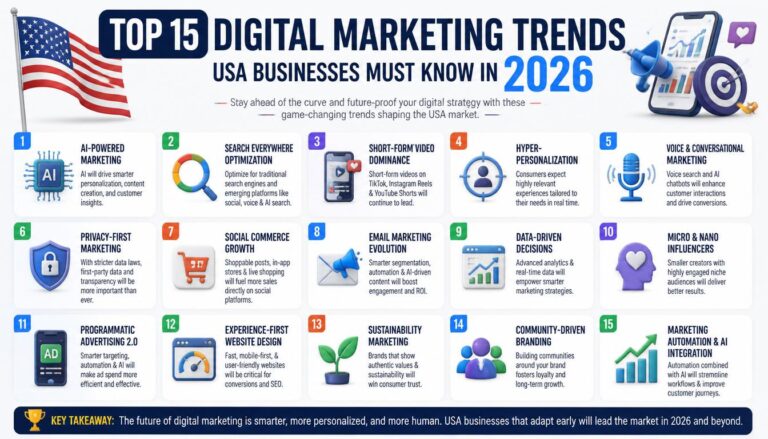
AI isn’t some fancy add-on; it’s the foundation now. Marketers are using AI agents to handle everything from drafting emails to optimizing ad bids in real time. But here’s the humor in it—AI can churn out content faster than you can say “chatbot,” but if it sounds like a robot trying to sell you insurance at 2 a.m., nobody’s buying. Trends point to hyper-personalization as the big winner. Seventy-five percent of consumers are more likely to purchase when content feels made just for them. First-party data (the info customers willingly share with you) is king because cookies are basically extinct, and privacy laws in over 20 states make third-party tracking a legal minefield.
Short-form video rules the roost—TikTok, Instagram Reels, YouTube Shorts. User-generated content (UGC) and authentic, “real” posts beat polished ads every time. Social commerce is booming too; nearly half of US consumers say social media is where they discover and buy products. Meanwhile, search is evolving. Traditional SEO is shifting to AEO (Answer Engine Optimization) and GEO (Generative Engine Optimization) because people ask AI tools questions instead of typing keywords. Voice search, AR try-ons, and community-first platforms are the new normal. And measurement? Forget just counting clicks. It’s all about full-funnel impact—did that post turn a browser into a loyal customer who sticks around?
The USA market is unique because of its size, diversity, and patchwork of regulations. From California’s strict privacy rules to New York’s ad disclosure laws, you’ve got to stay sharp. Economic pressures mean budgets are tighter, so efficiency wins. The good news? If you build your plan right, you can punch way above your weight class. Now, let’s get into the steps.
Step 1: Define Your Business Goals and Objectives (Make Them SMART or Go Home)
You wouldn’t drive cross-country without a destination, right? Same with marketing. Start by nailing down what you actually want. In 2026, vague goals like “get more followers” are about as useful as a chocolate teapot. Use the SMART framework: Specific, Measurable, Achievable, Relevant, and Time-bound.
For example, instead of “grow sales,” try: “Increase online revenue from US customers by 25% in the next 12 months through targeted email campaigns and social commerce.” That’s specific, you can track it with analytics, it’s realistic if you have the budget, it ties to your business, and it has a deadline.
Why does this matter so much now? Because AI tools make it easy to chase shiny objects—new platforms pop up weekly—but SMART goals keep you focused. Sit down with your team (or just yourself if you’re a solo act) and list 3-5 big objectives. Maybe it’s boosting brand awareness in the Midwest, cutting customer acquisition costs, or launching a new product line.
Pro Tip with a Laugh: I once worked with a client who set a goal to “go viral.” Six months later, their only viral moment was a typo in an ad that made everyone laugh—at them. Lesson learned: Goals need guardrails.
List out your goals in a simple table like this for clarity:
| Goal Number | SMART Goal Example | Why It Matters in 2026 |
|---|---|---|
| 1 | Grow email list by 15,000 US subscribers in Q1-Q2 | First-party data is gold for personalization |
| 2 | Achieve 4x ROAS on paid social ads by year-end | Ad costs are rising; efficiency is everything |
| 3 | Increase organic traffic from AI search by 30% | Traditional Google is changing fast |
Step 2: Know Your Target Audience Inside Out (No More Guessing)
Your audience isn’t “everyone who breathes.” In the diverse USA market, that approach flops harder than a bad stand-up routine. Dig deep into buyer personas. Who are they? Age, location (urban vs. rural matters huge here), income, pain points, where they hang out online.
Use surveys, Google Analytics, social insights, and even good old customer interviews. Tools like polls on Instagram or email feedback forms work wonders. In 2026, hyper-personalization means knowing not just demographics but behaviors—like what time a busy mom in Chicago scrolls TikTok versus when a retiree in Florida checks email.
Create 3-4 personas. Example: “Tech-Savvy Sarah,” 28, lives in Austin, loves sustainable brands, discovers products via short videos and AI recommendations. Her challenges? Overwhelmed by choices, trusts UGC over ads.
Funny story: A friend tried marketing energy drinks to “young athletes” without realizing half his audience was actually desk-job folks craving a 3 p.m. pick-me-up. Once he refined personas, sales jumped. Ask questions like: What keeps them up at night? What makes them click “buy”? How do privacy concerns affect their trust?
Step 3: Conduct a Thorough Market and Competitor Analysis
Before you spend a dime, look around. What are competitors doing? Use free tools like SimilarWeb or Ahrefs (lite versions) to spy on their traffic sources. In 2026, check how they’re showing up in AI summaries or community forums.
Do a SWOT analysis: Strengths, Weaknesses, Opportunities, Threats. Your small business strength might be nimble, authentic content while big brands struggle with “corporate vibes.” Opportunity? Untapped niches like voice-optimized local search in your state.
Market trends: Economic uncertainty means value-driven marketing wins. Sustainability, inclusivity, and real talk resonate. List competitors in a table:
| Competitor | Strengths | Weaknesses | Your Edge |
|---|---|---|---|
| Big Brand X | Huge ad budget | Feels impersonal | You can be more authentic and responsive |
| Local Rival Y | Strong community | Weak video game | Short-form video + UGC focus |
Step 4: Selecting the Perfect Mix of Digital Channels for 2026
Not every channel fits every business. In the USA, focus on where your audience actually is. Here’s a breakdown with 2026 twists.
- SEO and Answer Engine Optimization (AEO/GEO): Traditional rankings still matter, but optimize for AI answers. Think structured data, conversational FAQs, and helpful content. Organic search ROI is sky-high—up to 748% in some reports.
- Social Media and Short-Form Video: TikTok, Instagram, YouTube, and emerging community platforms. UGC and live shopping drive sales. Authenticity beats perfection—people are tired of polished “influencer” perfection.
- Email Marketing: Still the ROI champ (around 36x return). Use AI for segmentation but keep copy human. Newsletters with real value build loyalty.
- PPC and Paid Social: Google Ads, Meta, TikTok ads. Programmatic buying is efficient, but focus on ROAS. Mobile-first everything.
- Influencer and Affiliate: Micro-influencers with real communities crush it. Social commerce blends shopping and scrolling seamlessly.
Table for quick comparison:
| Channel | Pros in 2026 | Cons | Best For |
|---|---|---|---|
| SEO/AEO | High ROI, long-term traffic | Takes time | Brand visibility, trust |
| Social Video | Viral potential, engagement | Algorithm changes | Awareness, sales via commerce |
| Direct, owned audience | Spam filters | Retention, repeat buys | |
| PPC | Fast results | Costly if not optimized | Quick wins, testing |
Step 5: Building Your Content Strategy That Actually Works
Content is still king, but in 2026 it’s more like a helpful friend than a loud salesperson. Focus on quality over quantity. AI can help brainstorm and draft, but human touch ensures it doesn’t sound like “AI slop.”
Plan a content calendar: Mix educational posts, entertaining videos, behind-the-scenes, and promotional stuff (80/20 rule—mostly value, little sell). Video dominates—short clips for discovery, longer for trust-building. Repurpose: One webinar becomes 10 Reels, a blog, and email snippets.
Humor helps: “Your content should solve problems, not create them—like that one uncle who talks politics at Thanksgiving.” Engage with comments, build community. Track what resonates via analytics.
Step 6: Allocating Your Budget Wisely (Because Money Doesn’t Grow on Trees)
Budgets vary, but aim for 7-12% of revenue on marketing, with most going digital. Sample 2026 breakdown for a $500k revenue business:
- Paid ads (Google, social): 35-40% ($12k-$15k)
- Content creation & SEO: 20-25% ($8k-$10k)
- Email & tools: 10-15% ($4k-$6k)
- Influencers/community: 10%
- Analytics/testing: 5-10%
- Misc (AR tools, compliance): 5%
Table it out monthly. Start lean—test $500 on one campaign. Track every dollar. Pro tip: AI automation can cut costs on repetitive tasks, freeing cash for creativity.
Step 7: Choosing Tools and Building Your Tech Stack
Don’t overcomplicate. Free/affordable starters: Google Analytics 4, Google Search Console, Meta Business Suite, Mailchimp or Klaviyo for email, Canva or CapCut for video. AI helpers like ChatGPT for ideas (but edit heavily), or specialized tools for AEO.
For bigger plans: HubSpot or similar for all-in-one. Budget for learning—tutorials are everywhere.
Step 8: Creating a Timeline, Implementing, Measuring, and Optimizing
Break your plan into quarters. Month 1: Research and setup. Month 2-3: Launch campaigns. Include buffer for testing.
Measurement is key. Shift from vanity metrics to real ones: Customer lifetime value, engagement rate, conversion rate, ROAS. Use dashboards for weekly reviews.
KPI Table Example:
| KPI | Target | Tool to Track |
|---|---|---|
| Website Traffic from Organic | +30% | Google Analytics |
| Email Open Rate | 25%+ | Email platform |
| Social Engagement | 5% rate | Platform insights |
| ROAS | 4x | Ad manager |
Staying Compliant and Ethical in the USA (Don’t Get Fined!)
Privacy laws are no joke—CCPA in California, similar in many states. Honor opt-outs, be transparent about data use. Disclose AI-generated ads or deepfakes per FTC guidelines. CAN-SPAM for emails, endorsements clearly labeled. It’s not sexy, but ignoring it is like forgetting your pants in a Zoom meeting—embarrassing and costly.
Common Pitfalls and How to Avoid Them (With Some Laughs)
Pitfall 1: Chasing every trend. “Look, AI agents!” Cool, but if it doesn’t fit your audience, skip it. You’ll waste time like I did chasing Pokémon Go for my business in 2016.
Pitfall 2: Ignoring mobile. Over 69% of ad spend is mobile—test on actual phones.
Pitfall 3: No testing. A/B everything or you’re guessing.
Pitfall 4: Forgetting humans. AI is great, but authenticity builds trust.
Real-World Examples to Inspire You
Imagine a small US apparel brand. They set SMART goals around sustainable fashion, targeted eco-conscious millennials via TikTok UGC challenges, optimized for voice search (“best organic cotton tees”), and used email for loyalty. Result? 40% sales growth with a modest budget. Another: A local service business used geo-targeted PPC and community Facebook groups—boom, booked solid for months.
Wrapping It Up: Your Winning Plan Is Ready
Creating a digital marketing plan for 2026 isn’t about perfection—it’s about progress and adaptation. Start small, stay consistent, inject personality, and use the trends (AI, video, personalization) without losing your human edge. The USA market rewards smart, authentic players who listen to their audience.
You’ve got the steps, the tools, and hopefully a few chuckles to keep it fun. Grab a notebook (or Notion), follow this guide, and tweak as you go. Your competitors might be winging it, but you? You’re building something that wins. Now go make 2026 your best year yet. Questions? Experiment and adjust. The digital game is yours to play—make it a good one.
About the Author